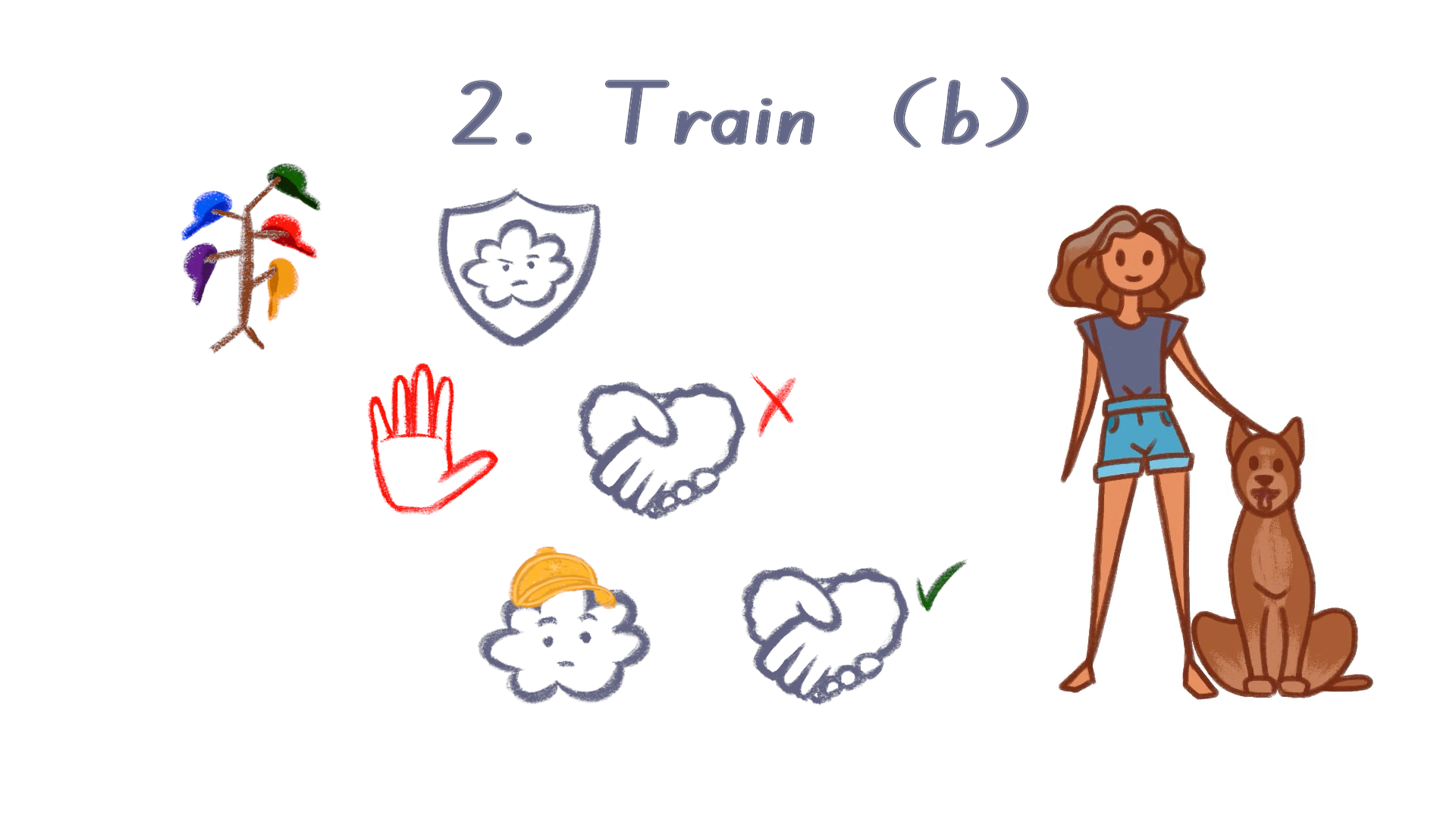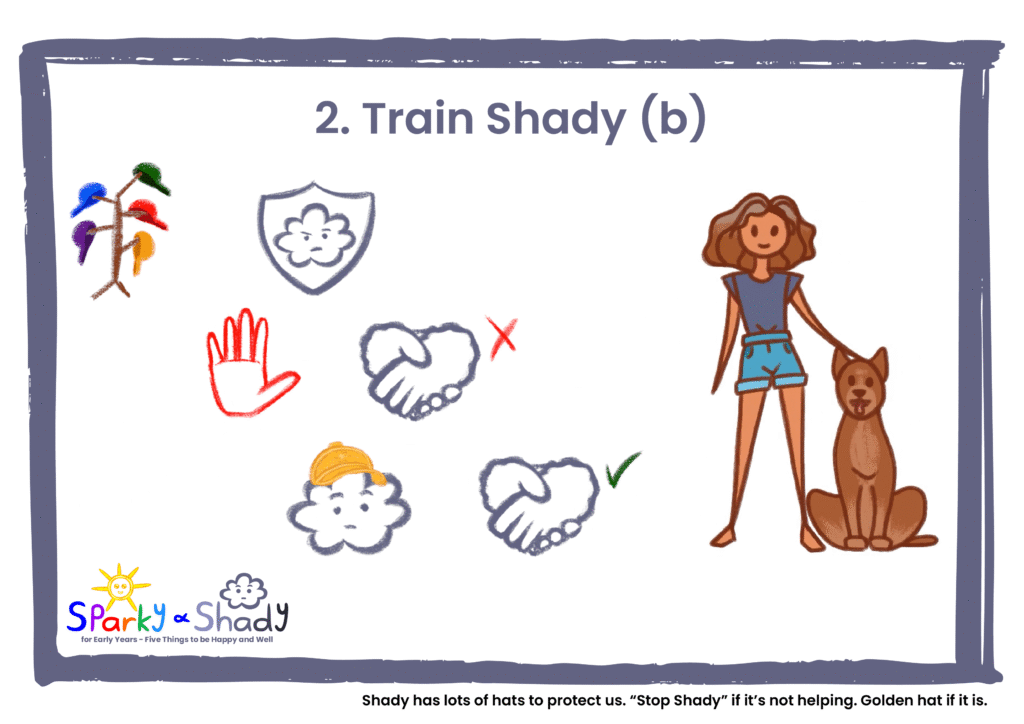
2. Train Shady
Educators
Prior to starting this lesson
- Download and read the written summary and transcript of the Train Shady videos, so you are familiar with the content.
- Print out the Train Shady a & b summary posters and the three strategy posters to use in this lesson.
When presenting
- Be open to presenting just the first, or both videos in this lesson. It will depend on your audience, setting and the time you have allocated. There is 7:04 mins of video content altogether.
- Start by reading through the Sparky and Shady folder you have made to revise the last two lessons’ content with children. Let children look at the pictures and contribute whatever comes up for them as you read the captions.
- Introduce the summary posters for Train Shady a & b. Ask children what they think the pictures might represent.
- Watch the first video together. You can pause the video at 1:05 min to have a talk about when the children have felt Shady inside them. (Anytime children feel bad, they are feeling Shady.) Talking about that scared feeling in their tummy when they are in danger is important as this is often when Shady helps protect our body.
- Around 1:50 min ask children if they could imagine their Shady. At the end of the video, check with children that their Shady agreed to let Sparky help them.
- You could watch the second video straight away if the children are still engaged. They might like to draw their Shady now if they want to either while watching the second video or as the follow up activity.
- When you watch the second video – either now or next time, talk about how Shady needs help to learn to be kind.
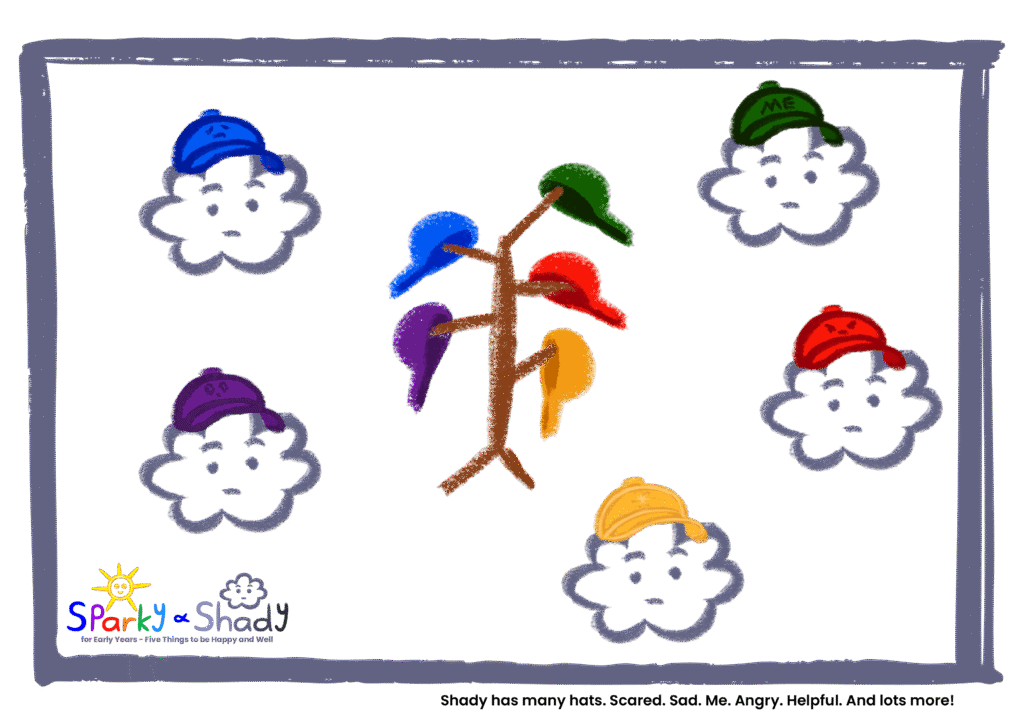
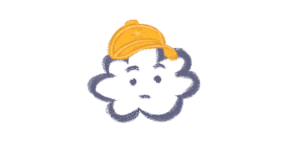
- Talk about the video or videos – anything that comes up. Take care not to shame children when discussing Shady behaviours. Remind children they are human and Shady is an important part of being human. We want our children to train their Shady to wear the golden helping hat.
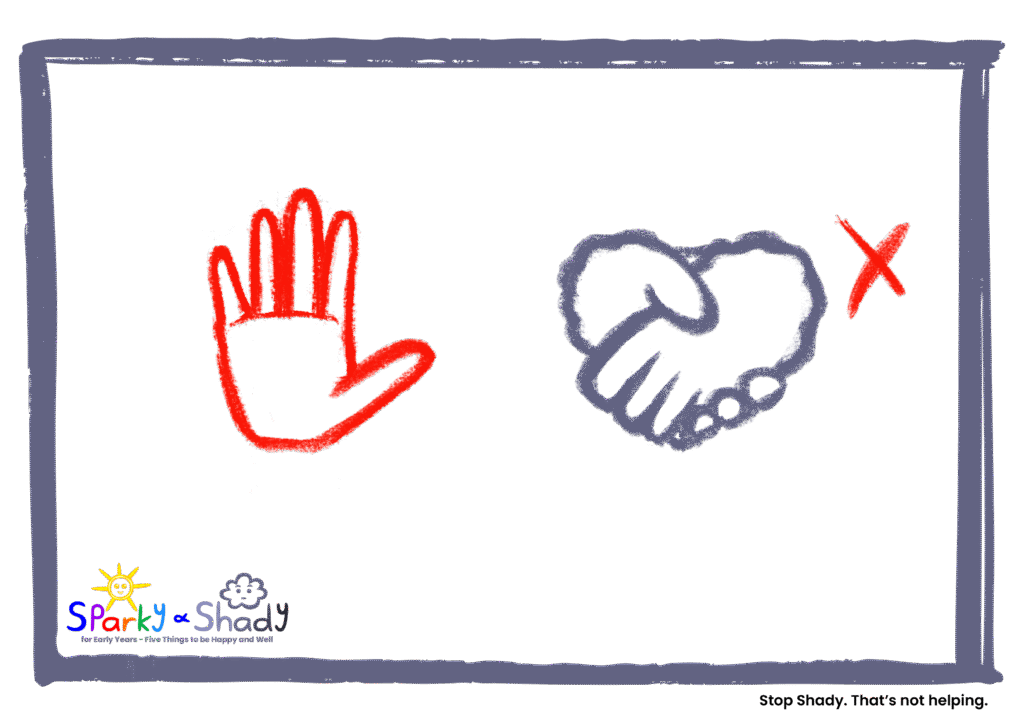
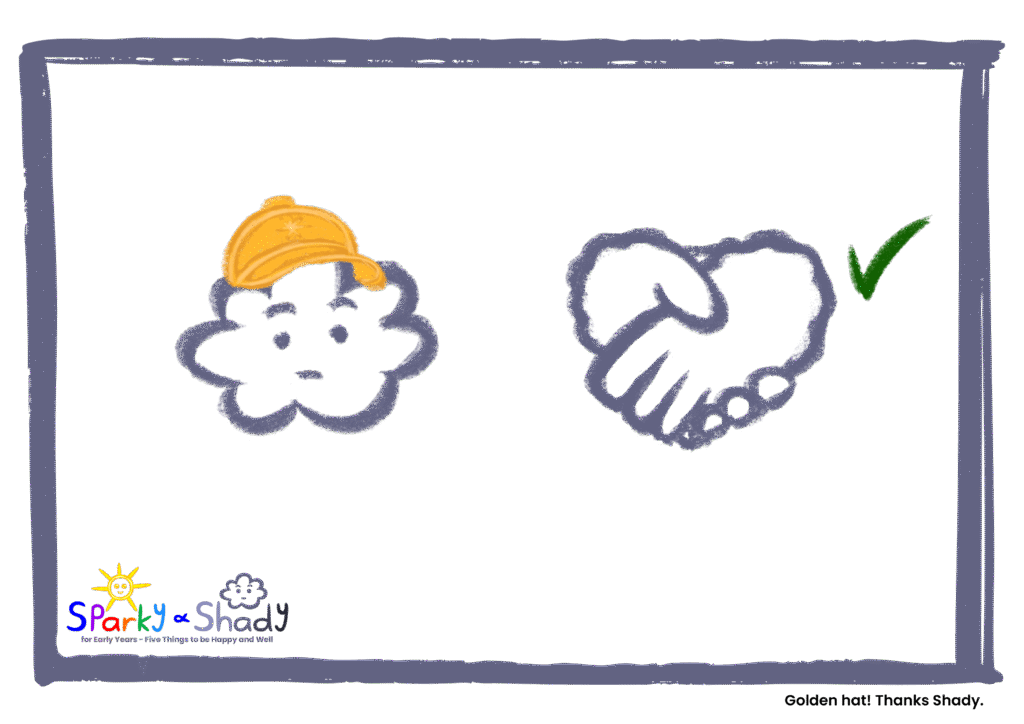
- Refer to the summary and strategy posters and read the captions at the bottom.
- Ask the children to draw a picture of Shady (if they haven’t already).
- Pop drawings and posters in the folder.
- Check out ‘More for Educators’ at the bottom of this page when you have time.
- If you decided to watch the first video, come back to this lesson and revise the content in your scrapbook or folder with children before watching the second video.
❤️ Kathy
Train Shady
3:34
3:30
Drawing Activity
Draw a picture of your Shady. You can draw whatever you like.
Families
How This Works
- Read the grownup notes.
- Print out the summary and strategy posters, pop them in your folder.
- Watch the first and second videos with your child, either back to back or when it suits you best.
- Talk about each video after watching, use the posters as prompts.
- After the second video, ask your child to draw Shady (if they want to).
- Read the tricky tips for grownups.
- Now your child is familiar with Sparky and Shady you can introduce a daily meditation to their routine (choose from morning, daytime and bedtime). They are at the bottom of this page.
- Have a least one sleep on the Train Shady content before you move onto the next lesson.
❤️ Kathy
Summary Posters
Grownup Notes
Shady is…
Scared, protective, worried we won’t get our physical, emotional, mental, social and spiritual needs met, competitive, judgmental, self-serving, our conscience… and more. Shady is the source of our disconnect, shame, anger, guilt, ego, jealousy, arrogance and more.
Shady lives in…
Our head. In our imagination. In everyone.
Choice
Human beings are often in Shady. We think, feel and behave in Shady ways automatically – when we get triggered, when something goes wrong, or when we have to do something new or challenging. This is part of our evolutionary survival mechanism – our negativity bias and our fight, flight or freeze response.
We are not Shady
We are whole human beings. We have a part of us (our conscious awareness) that can observe what Shady is thinking, saying and doing and… choose a different way.
“We can’t solve a problem with the mind that created it.” Albert Einstein.
I think Albert meant – we can’t solve a problem caused by Shady while we are in Shady.
We need another part of us to solve it – Sparky.
Real life
My youngest son participated in lots of Sparky and Shady workshops when he was growing up. When he was older, I asked him, “Matey, what is one thing you learnt from Sparky and Shady that you use everyday?” He said…
“I don’t have to believe Shady.”
❤️ Kathy
Strategy Posters
Tricky Tips for Grownups
Shady is not bad. Shady is scared.
- It’s important that children learn to love their Shady — so they can learn to love their whole self.
- Shady is a part of us, the scared part of us.
- Shady is the worried and judgemental thoughts we think over and over again. Our fearful inner thoughts and self-talk are Shady.
- Our inner voice and thoughts are neural pathways that were first formed from birth to seven years old. Unless we have changed these, they may still be the same.
- When we were little our Shady grew from observing and listening to others. Our inner Shady self-talk is often a reflection of what the people around us said to us and about us when we were little. Most young children are very good at spying on the grownups, and listening to what they say about them.
- Our Shady also grew from the sense we made of what was happening around us. If we wanted Dad’s attention and he didn’t give it to us, our Shady told us, “Daddy doesn’t love me”.
- Our internal Shady was also created from our fear response in our downstairs brain (Dan Siegel) but then our Shady became habitual and a part of our personality – who we are.
We can be in Shady
- We can be in Shady but not in our fear response (dysregulated).
- Our children’s Shadys are forming right now. Everything we say and do influences the way their Shady develops in their personality. We can help them train their Shady.
- Imagine two dogs – one growing up with owners who train the dog in loving ways to be respectful, protective and supportive. The other dog growing up with inconsistent owners who do not train it. Which dog is going to be easier to live with?
- We want our children to have helpful thoughts and helpful inner self-talk when they are older. This helpful inner self-talk comes from Sparky. Our children can hear their Sparky when they learn to train their Shady.
- If we help our children train their Shady with love, patience and time, their Shady will learn to protect them in helpful ways — that’s Shady’s golden hat.
When your child is in Shady
- A “Shady moment” means your child is dysregulated — they’re in their downstairs brain reacting, OR they are behaving on autopilot in the way they have learnt to behave OR they are choosing to behave in a Shady way to meet their needs OR their body needs something.
- Children have physical, emotional, mental, social and spiritual needs.
- To help our children return to the part of them that can observe and choose (their upstairs brain or conscious awareness):
– Get into your own Sparky.
– Send them love. Connect with them.
– Hold a safe, supportive, loving space until they return to themselves (become regulated again) and are ready to come out of Shady.
What not to say in the moment
- Avoid saying things like:
“That’s so Shady.”
“You’re being Shady — stop it.”
“Is that Sparky or Shady? Sounds like Shady.”
“Control yourself. You are doing this on purpose.”
- Why?
– When we respond like this we are in Shady, trying to protect our child – but it isn’t helpful.
– We are our child’s most important role model, they do what we do.
– What we say to them becomes what they say to themselves in their own inner thoughts and self-talk (Shady in their head).
– We can trigger shame and children may start hating on themselves and their Shady.
– Neurologically, children cannot choose a different thought or behaviour when they’re unconsciously in Shady!
– We want them to choose to get out of Shady themselves so they can meet their needs in a Sparky way.
What you can say and do
- Sometimes you’ll need to say “Stop” and raise your voice to keep your child or other children safe (Shady’s golden hat).
- Other times you can call out Shady (respectfully), “Shady is not helping you.” And offer help, “Can I help you?”
- If your child is willing to accept help, ask them, “What is your Shady saying?” Listen to everything their Shady is saying, let them feel their emotions and when they are calmer ask them to ask Sparky for help.
- Alternatively, you could go straight to… “Sparky can you help us please?” And remove any danger. This may be enough to bring them back into themselves.
What to say later
- When your child is back in themselves, gently say something like:
“It looked like your Shady was trying to protect you before when you were hitting your sister. What was Shady saying to you?” - Follow up with:
“Ask Sparky for help so you know what to do next time.” Then discuss what your child’s Sparky suggested. If they can’t hear Sparky, tell them what your Sparky suggests. - When your child behaves in a Shady way it is an opportunity to teach them how to self-regulate and get out of their Shady. It is a chance to teach them how to meet their needs in a different way.
- The best way to help a child self-regulate is to co-regulate, hence the ‘get into Sparky yourself’ suggestion and then ask Sparky for help.
- Role modelling is also great. When your Shady is not helping you, you can role model by saying:
“Stop Shady, that’s not helping.”
And then if appropriate tell your child what your Shady was saying in your head and how this wasn’t helping you.
Grownups have Shady too
- Responding to Shady behaviour in a Sparky way takes practice.
- As parents and carers, we often go into our own Shady and react the way we always have.
- Most grownups didn’t learn this stuff when we were kids — so please,
be kind to yourself as you retrain your Shady. - When you are Shady with your child, apologise and use it as a teaching moment. “Sorry I yelled at you, I need to train my Shady to be more patient.”
- We are all going to make mistakes. It is okay to make mistakes. It is okay to be human – this is one of the most important lessons we can teach our children.
Real life story
I was driving my granddaughter home in her family car when she requested a song. I told her I couldn’t play the song because I wasn’t in my car and didn’t know how to play the song in her car. She started screaming at me (loudly) to play her song as she kicked the back of the seat (hard) with both feet. I gently said, “Gracie, could you ask your Shady to stop yelling at me and stop kicking the seat please?” I could hear Gracie talking to her Shady in the back, “Stop it Shady, she doesn’t like it.” I pulled the car over and worked out how to play the song. Gracie said “Thank you Nan. I told Shady she wasn’t helping.” (The names were changed, but the story is otherwise completely true!)
❤️ Kathy
Meditations
The Soundcloud meditations can be downloaded or streamed.The Spotify links can be streamed. These are also available in the Materials section.
❤️ Kathy
More for Educators
Follow up
- Now the children have met Sparky and Shady you can use the daytime meditation at quiet time or after second lunch to support children to connect with Sparky and train Shady. The morning meditation could be helpful too. The bedtime meditation is ideal for families to use at home.
- 3 – 4 year olds probably won’t do a drawing or talk much about the videos, that’s okay! We are planting the seeds. It would be ideal if children had the freedom to come and join in or to wander away from the activity, to suit their interest. For this reason, it may be worth offering the same lesson two or three times a week for younger children.
- 4 – 5 year olds may enjoy drawing and/or talking about the content, they may talk about Shady at other times too as they are working out how their Shady works.
- 5 – 6 year olds could benefit from other stimulus related to Shady to reinforce the idea that they are in charge of their Shady.
- 6 – 7 years olds will be seeking more stimulus and asking lots of questions about Shady. They may point out other children’s Shady behaviour too. When they do your reply could be, “If they are being Shady, they must be human!”
- Aesop’s fable The Boy Who Cried Wolf is included in the Materials tab. The story has been adapted to include Shady talking to the boy in his thoughts, to give an example of what Shady could say. Read this to children and talk about whether Shady was helping the boy or not. One of Shady’s jobs (or hats) is to be our conscience (moral reasoning), this is often helpful.
- When reading the story ask the children to get comfy, and imagine the story happening in their imagination.
- The game Doggy, Doggy, Who Stole the Bone, is included in the Materials tab. It is a great game to stir up children’s Shady – “That’s not fair”, “He already had a turn”, “I never get a go.”
- Younger children might like the story and game too!
- You will know what is best for your children and your setting.
Strategies
- Remember that young children are either in Sparky or in Shady and rarely in their conscious self.
- When young children are being Shady it could be accompanied by a sympathetic nervous system response where their body is going into fight, flight or freeze to protect them. In this state children are dysregulated.
- When children are dysregulated it is not possible for them to access Sparky without going through their conscious self first.
- Our goal as educators is to support children to self-regulate so they can come back into a regulated state – parasympathetic response.
- From this regulated state children have choice.
- Physiologically, when children are safe, secure, seen, and soothed (Dan Siegel’s 4s’) they are in their parasympathetic nervous system which means they are relaxed, calm and capable of choosing.
- When children are in Shady – stay calm, supportive and give children the 4s’ – make sure they know they are safe, secure, seen and soothed, so they can return to a calm state themselves.
- It is important not to shame children for being Shady, they are learning to train their Shady, this is a hard thing to do! We want to support them.
- There is no need to rave on about Shady. Use the word ‘Shady’ sparingly when children are dysregulated. We don’t want them to feel ashamed of themselves and hate their Shady because they associate ‘Shady’ with getting in trouble or being lectured by grownups.
- Talk in retrospect about Shady situations with children, “What was Shady saying to you before when you were upset about not getting a turn in the game?” “Did that help you?” “I wonder what Sparky would have suggested.” “Let’s ask Sparky for help now so you know what to do next time.” “Sparky, can you help us please?”
- Model talking to Shady yourself – “Stop Shady, that’s not helping” and then explain the context to children – “Shady just told me leave that rubbish on the floor for someone else to pick up, is that helpful?”
- There is an Understanding Sparky, Our Self and Shady chart in the Materials tab that shows different aspects of Sparky, our conscious self, Shady with the golden hat and Shady with other hats. It is at an educators level and is supplied to support your understanding of the concepts. Enjoy!
❤️ Kathy
Materials
(In the paid version these are all downloadable)
Train Shady Transcript
Train Shady Summary a Poster

Train Shady Summary b Poster
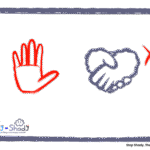
Stop Shady Poster
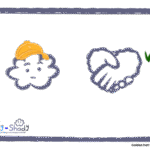
Golden Hat Shady Poster
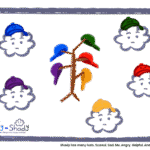
Shady Has Many Hats Poster
The Boy Who Cried Wolf

![]()
Doggy Doggy Who Stole the Bone

Understanding Sparky and Shady
Morning Meditation V1
Daytime Meditation V1
Bedtime Meditation V1